
The Immigrant Anthem
Kalyan Ray is professor of English Literature at County College of Morris, New Jersey.


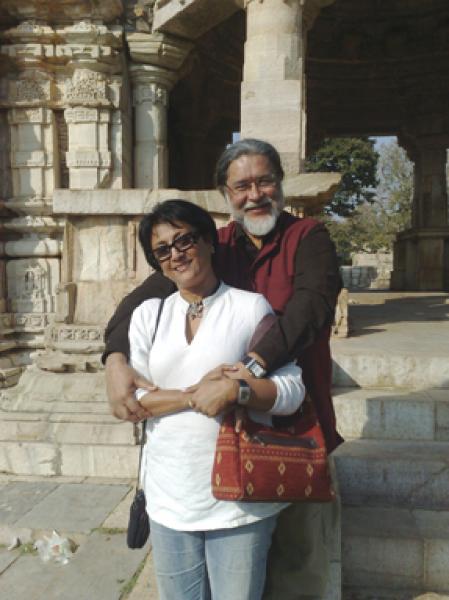 Caption
When I first came to America — from Delhi, in the early 1970s — I was very young. It took me a while to get a drift of the place. It was a nation in transition. The country was coming out of the Vietnam War, war protests were in decline. Conservatism was the new buzzword with the new Pres. Ronald Reagan defining it. The cult of greed seemed to be lurking in the shadows, waiting to announce its presence. It was really, (when I now look back), another time, another place .…
The profiles were different too. My generation of NRIs comprised largely of students, doctors, engineers, or teachers. Many, soon enough, brought over their “poorer” relatives to make it one large extended family. This gave rise to improvisation, which, in some fashion, started the Hotel-Motel-Patel movement. Kiosks and grocery stores became their terrain and very soon they dominated that space. NRIs were perceived as a community that was nimble-footed, blessed with a shrewd business sense, amazingly hard-working, smart with money, driven by a passionate sense of tradition and family values, which subscribed to simple living and generally zoomed way ahead of other immigrants on the economic barometer.
Their kids, and the new bunch of NRI youngsters who followed, were however a planet apart. They represented the second wave. Ambitious, aspirational, highly-motivated and evolved, they were a group of over-achievers totally in the loop of the here and now, not babes-in-the-wood of our time. Around this time, Silicon Valley happened and this brilliant, sharp lot, meshed in with a speed and quality to really make huge waves. For them (unlike our or earlier generations) there was no lack of tuning to the atmospherics of the American way of life. Like the author Jhumpa Lahiri, they were totally comfortable with both the immigrant experience and Uncle Sam’s anthem.
Very quickly, the heat was on. In-sourcing explodedVery quickly, the heat was on. In-sourcing exploded Smart, bright, young kids, hot n’ heavy on the digital wave were invited en masse to the land of Coke, Apple Pie, Madonna and Steve Jobs to do their number. After a while it struck the big boys that it would perhaps make a lot more sense to outsource jobs to India because of the economics and the ready-made availability of a huge, professionally-trained, English-speaking work-force, hot wired to the cyberworld. That marked the beginning of the BPO boom in India.
All this action — consciously and subliminally — did impact the perception of India among average Americans. It was no longer seen as a country of sadhus, snakes, camels and beggars. It was a fantastic resource of brilliant software talent. A hot n’ happening land where the new-gen kids were indeed fabulous and could teach them a thing or two. Suddenly the relationship between the two largest democracies on earth, changed. Today, India is seen as much as a collaborator as competitor, a nation that has enough self-esteem and self-confidence to demand her place in the sun.
Where does all this place the NRI in today’s life and times? In the most amazing slots, filling the most unexpected places and playing out truly never-before roles. They are gracing the boardrooms of blue chip corporations. They are acknowledged as respected major players in the world of business and industry.
Indians are also confidently partaking of both worlds without any baggage. When I first came to this country, I was constantly asked: How Indian are you? The idea was that if you are 60% Indian, you are 40% American. Today this question is irrelevant and dumb, because the private and public lives are beginning to be constantly re-examined and re-explored. The young kid, working in a BPO in Bangalore is likely to have more in common with the kid in New York than Jharkhand, Orissa or Uttar Pradesh. I remember those early trips back home with my suitcase full of stuff you died for in India … LP & EP records, clothes, electronic gadgets, cigarettes, booze, perfumes, etc. Today it’s a joke. Everything is available there.
Once the world, certainly India too, saw America as the promised land, the glamorous, successful, sexy giant — Gary Cooper in orbit. That entire image went through a cataclysmic sea-change post-Vietnam in the eyes of the Americans themselves. Today there is much more introspection, self-doubt and a clear-eyed look at the big picture.
Is the new-age NRI confused? Yes … but about new things. Like their stated sexuality, place and line of work, the kinds of food they want to sample, relationship pattern, conflict between tradition and contemporary takes on life .… I’ve always believed that confusion is a positive thing because it kills both rigidity and complacence.
There is another dilemma that confronts the earlier NRIs like me — whether to stay back in old age in America or go home? Yeats says that America is not a country for old people and he could’ve been right. But a group of Indian Americans are actively putting together Old Age Homes for the NRI community. I certainly plan to return, but that’s because I have very strong familial roots in India, but there are thousands who’ve been here too long and going home doesn’t make sense any more. Or people who live with their entire extended families in the USA, so they have no reason to return.
Interestingly, in the year 2009, the quality of nostalgia has also dramatically changed and technology is responsible for killing all the romance linked to it. Remember the time we all waited for that letter … or that quick phone call because it was so expensive and how excited we were at hearing some stray sounds — Hindi songs on the radio, bus or tram sounds, anything …. They immediately provided a huge emotional connect with the far away and long ago and transported us, briefly, to that place. Today, the cell phone connects with home, instantly! Earlier, we couldn’t dream of trips back home as frequently as we wanted, because we were always broke and travel was expensive. Today, kids are on that flight to and from America, all the time.
That’s globalization for you, I guess …
Little India invites first person accounts and perspectives for its Indian American Encounters columns. Send submissions to editor@littleindia.com
Image gallery


 Email to a friend
 Print version
Recent Posts
- Go4Medicare: Online Clinic Franchisee Network
- PVC Podiums: The Smart Choice for Style, Durability, and Cost Efficiency
- Telemedicine Franchisee in India: Growth Oriented Business Model as Healthcare Investment
- Ladies Garments Franchise Business in India: A Detailed Industry Insight
- Ratnagiri Forever Chemicals Row Intensifies: Parliamentary Spotlight and Local Resistance